Our latest open access article is now online in the Journal of Asian Architecture and Building Engineering: “Responsive architecture in riparian zones: synthesising spatial design interaction along the North Khlong Om Non-canal” (Patiphol Yodsurang, Asadaporn Kiatthanawat, Natcha Wattanamano, Aracha Krasae-In, Kuntarut Yodpichai, Narumon Saratapun). Published online 22 January 2026. DOI: 10.1080/13467581.2026.2620905.
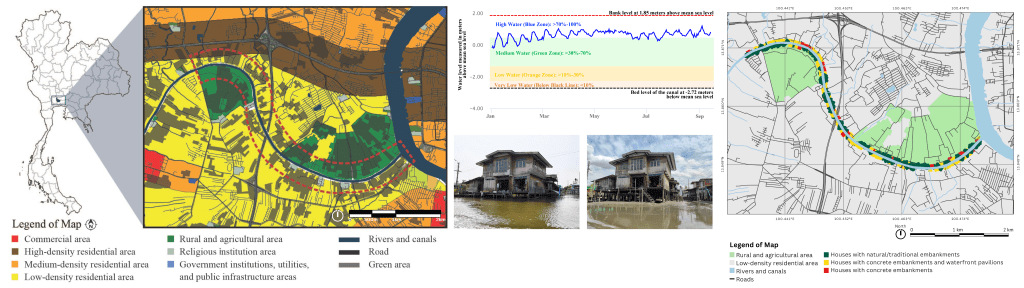
This study focuses on Sai Ma along the North Khlong Om Non canal, a riparian setting where everyday living must constantly negotiate water level changes, microclimate, vegetation, and the cultural routines of canal-side communities. Using GIS analysis and field observation, we mapped 467 building footprints and examined how embankments and “underneath spaces” shape spatial interiority and human environment interaction. The research frames riparian architecture not as a fixed object, but as a living interface between land and water.
We identified three dominant housing typologies. First, traditional embankments with dynamic underneath spaces that expand daily life into multi-level platforms and steps. Second, concrete embankments with waterfront pavilions that keep some social connection to the canal, but are more constrained. Third, concrete embankments without pavilions where the edge becomes sealed and the house turns away from water, often prioritising road access and enclosure. Across these types, the key difference is not only material, but the degree of ecological and cultural integration that the dwelling can sustain. The findings show that vernacular adaptive knowledge remains highly relevant for climate adaptation and liveability. Traditional designs use multifunctional underneath spaces as flexible thresholds that respond to tides, seasonal conditions, and livelihood practices. In contrast, modern concrete structures shaped by regulation and urban pressure often reduce permeability, biodiversity connection, and everyday water-based interaction. This shift matters because it changes how communities experience the canal, how they manage water risk, and how cultural continuity is maintained in rapidly transforming waterfront corridors.
For Riverfront Research Alliance, this paper reinforces a core message of our work: riverfront and canal-side settlements are not just “edges” to be hardened, but socio-ecological systems where design decisions shape resilience, identity, and daily life. We hope the article is useful for designers, planners, and local stakeholders working on canal regeneration and flood adaptation, especially in contexts where legal constraints and urbanisation are pushing settlements away from water.


Leave a Reply